GUETO JUDÍO
The Jewish Ghetto in Rome is a quaint area next to the river, nestled behind the ancient remains of Teatro Marcello, a Roman theatre built by Augustus for his nephew (that resembles the colosseum) and part of the Portico D’Ottavia (built for Augustus’ sister) which was used as the main fish market until the early 1900s. Today it is popular with locals and visitors alike for its traditional Jewish bakeries and restaurants (particularly on a Sunday) and is among the most highly-valued land in the city. Nearby, you will find a quaint little piazza with the beautiful Turtle Fountain (Fontana delle Tartarughe).
The Jewish population of Rome dates back to the second century BC, they were tradesmen, businessmen and diplomats who lived in Trastevere along with a community of Christians, Syrians and other foreigners. In the first century AD after the Jewish war under Titus, many Jewish slaves were brought from Israel who would eventually become part of the Roman community. Much later, in the 1490s, Jewish communities were expelled from Spain, Sicily and the south of Italy under Isabella and Ferdinand of Spain, they came to Rome seeking refuge.
RAISING OF THE WALLS
The Ghetto was established in 1550 and Rome’s Jewish community were forcibly moved to houses in a cramped, low lying area of the city that was prone to flooding. So began a dark period for the Roman Jews; gates were built between the buildings which were closed at night, a curfew was imposed and Jews were forced to wear yellow symbols (scarves and veils) that marked them out when they left the ghetto. Stripped of citizenship and property rights, they were allowed only a few menial occupations and prevented from mixing with or doing business with their fellow Christian Romans. For over three hundred years the Jewish community of Rome numbering some 4,000 souls lived in 3 hectares – two large blocks of impoverished and disease-ridden housing.
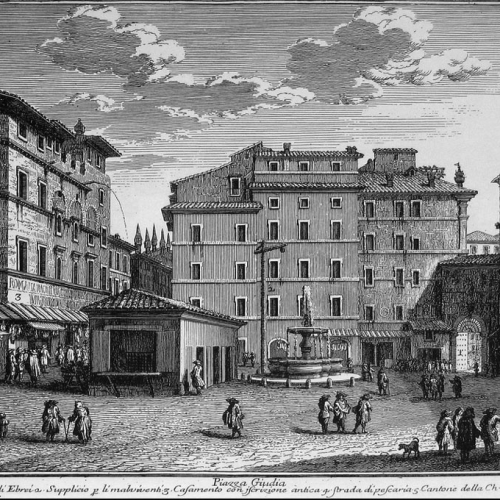
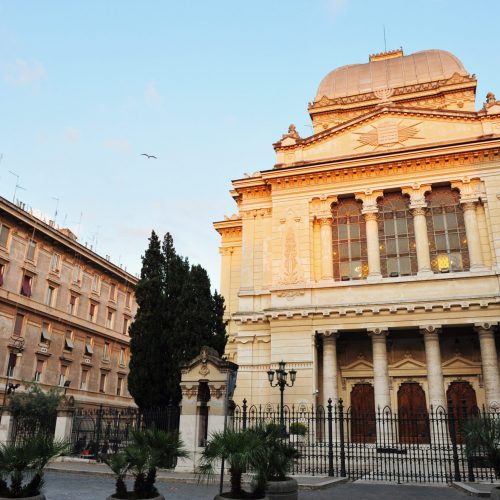
Italian unification in 1870 brought an end to the reign of the pope, state and church were separated; finally recognised as citizens, the Jews were liberated from the ghetto and it was razed to the ground. Not much of the Jewish Ghetto of old remains, today, the Great Synagogue of Rome stands on the site of the former ghetto, built in 1904.
Visitors can learn about the history of the ghetto at the Jewish Museum of Rome (Museo Ebraico) and take a guided tour of the synagogue.