Overview
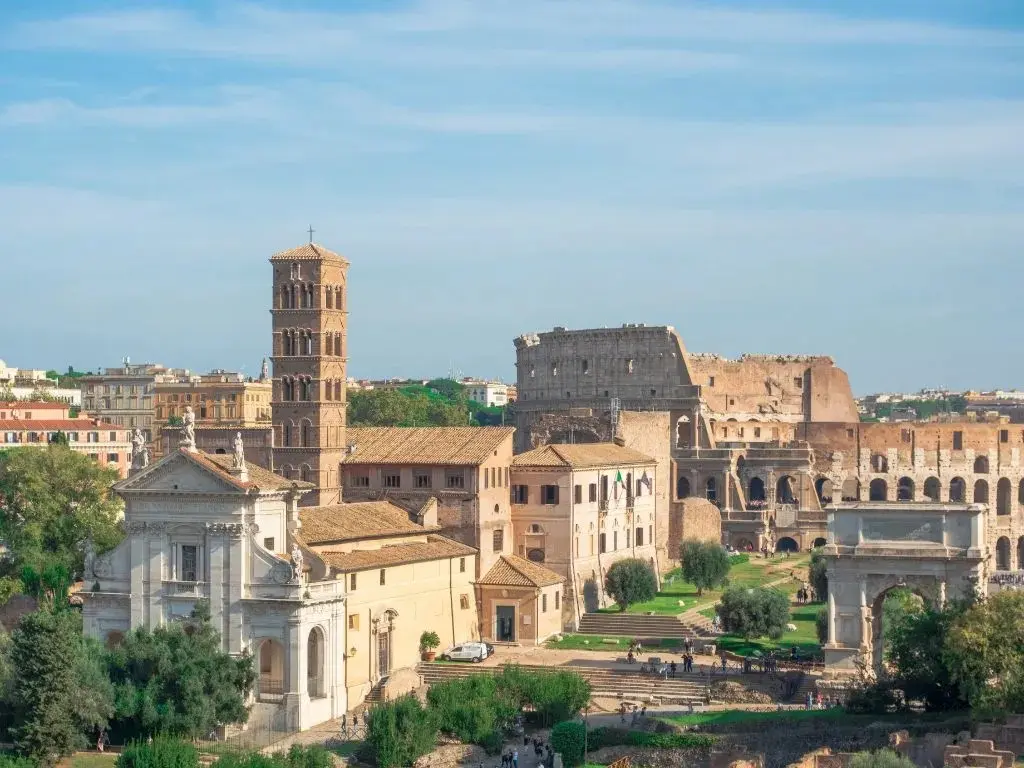
The Roman Forum is the centre of ancient Rome, it is also the largest inner-city archaeological area in the world. Nestled between the Capitoline and Palatine hills, for over a thousand years this area was the thriving civic, commercial, political and religious centre of the city. Like our city centres today, this is where most Romans spent their daily life – working, attending meetings, voting, shopping as well as attending various celebrations and parades. Today we can see the remains of Basilicas (law courts and public meeting places), the curia or senate house where people voted and the civic records office the Tabularium. On the raised street (via nova) are a number of shopping units and market stalls would have popped up on any street corner. Numerous temples (or remains of them) are scattered around the forum, most of which were converted into Christian churches later on. Today much of the area is a skeleton of its former greatness lacking the grand buildings, beautiful columns, arches and statues. Visiting the forum, we can appreciate the centre of an ancient empire that ruled the Mediterranean for over a thousand years.
Explore the History of the Roman Forum


The Most Important Roman Forum Monuments
As you walk around the Roman Forum today it can be difficult to imagine the buildings and what they were for – here is a list of the most prominent monuments you will see.
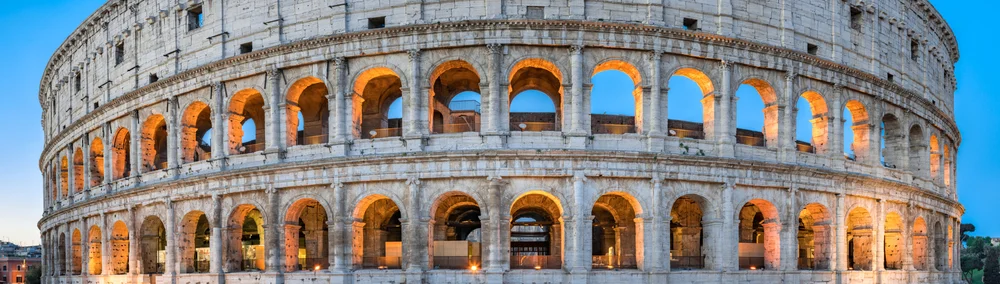
Temple of Venus and Roma – This huge temple precinct sits opposite the Colosseum. Built and designed by Hadrian in 135AD it was a double temple to the goddess Venus and Roma – the largest temple of its day and the first to the Goddess of Rome.
Curia or senate house – This huge building was the main political building of the forum; this is where senators gathered to vote. In front of the Curia was the Comitium, a stone circular seating area where they could discuss policy before voting (where the white canopy is today). What we see today was restored in the 19th century.
Tabularium – Dating to around the 1st century BC the public records or archives office of Rome was built into the Capitoline hill (today you can access the arches for an opposing view of the forum from the basement of the Capitoline museums). To imagine as it was you have to imagine away the 12th Century tower on the side and 14th century palace on top. It is named Tabularium after a number of tablets i.e. records were found here.
Temple of Saturn – One of the earliest temples still surviving, dating to the 490s BC (what we see today is from 400s AD). This is an example of the multi-use of temples in Roman times. The treasury of Rome was kept under this temple and the base held a number of official offices. According to the bible the city’s Jewish population offered money changing and money lending services here too. Not far from here was the golden milestone of Rome a huge gilded column which marked the distances in miles to major cities of the Empire
Remains of temple of Divine Julius Caesar – Built in 29BC by Augustus this temple is said to have been built on the site where Caesar was cremated spontaneously by a grieving crowd during his state funeral. It is significant because it is the first temple built to a man who becomes a god. This marks the beginning of the Roman state religion and the cult of the Emperor as a god.
Temple of Antoninus and Faustina - Built in 140AD by Antoninus Pius for his wife Faustina, his name was added later. You can still see the original temple porch, steps and altar (once covered in marble). It was converted to a church in the 8th century - notice the entrance to the church appears to be suspended in mid-air, this shows the difference in ground level from the 2nd to the 8th century. The church of S. Lorenzo in Miranda can be entered from the other side on the Via Fori Imperiali today.
House of the Vestal Virgins – This grand complex was the home and sanctuary of the Vestal Virgins. It had six apartments (3 on each side) on two levels (one for each priestess) and was originally lined by a portico that surrounded the apartments. At the far end (with two columns) is perhaps a ceremonial dining room and on the other end a small bathing complex. The statues are all of head Vestals from the 3rd and 4th Centuries AD. The small circular reconstruction is the Temple to Vesta which originally held a sacred flame.
So-called temple of Romulus – Named after Romulus the son of the emperor Maxentius who died in 309 A.D. This round brick building is the only monument complete with the original bronze door and precious porphyry columns.
Basilica of Maxentius – This is all that remains of an enormous Basilica started by Maxentius in 306 A.D. and finished by his rival and successor Constantine. What we see today is the north aisle. It was the largest secular basilica in Rome and would become the blue-print for the first Christian churches in Rome.
Arch of Titus – This triumphal arch celebrates the Triumph (victory parade in 71 A.D.) held for the emperor Titus after his victory in Jerusalem in what is known as the Jewish war. The two panels show the parade passing through a triumphal arch with the loot taken from the most holy of temples on Temple Mount including the menorah, sacred symbol of the Jewish people. The other side shows the emperor Titus in his victory chariot at the head of the parade. The arch was finished after Titus’ death in 81-2 AD – in the centre of the arch you can see Titus being flown up to the sky on an eagle.
Interesting facts
Rebuilding the city Centre Until the 1st century BC, the forum was disorganised with wooden and terracotta buildings. When Julius Caesar came to vote at the Curia on day, he found a fish stall with rotting fish heads next to senate house. It was this that made him start his building plan to enlarge and rebuild the forum.
Go to the toilet in an ancient drain. The Cloaca Maxima was one the first construction project on the Forum. Today, the ancient drain runs underneath the Basilica Julia. So, if you use the toilets under the trees behind the basilica you will be flushing into a 2,600-year-old drain!
Party in the Forum In 2007 Valentino the famous designer celebrated his 75th birthday with an exclusive gala dinner for 500 people in the grounds of the temple of Venus and Roma. Guests ranging from Uma Thurman and Silvio Berlusconi to the Rothschilds and Borghese’s watched flying ballerinas and fireworks against the backdrop of the colosseum.
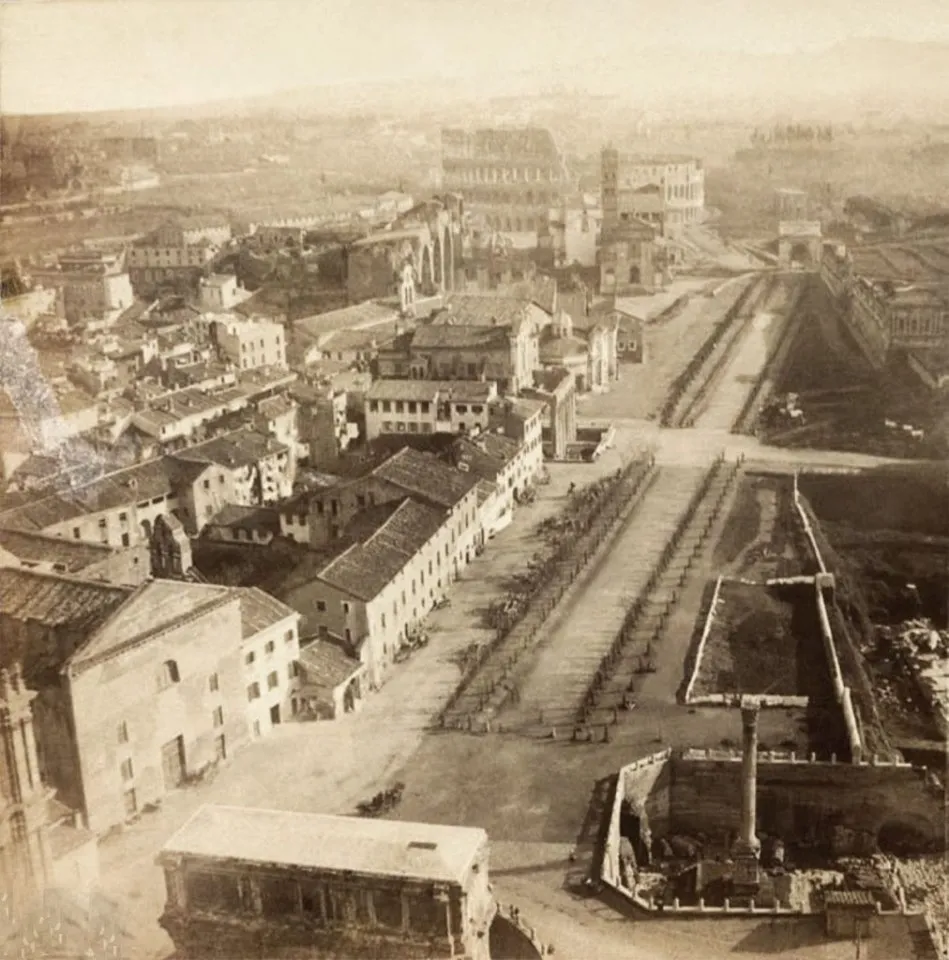
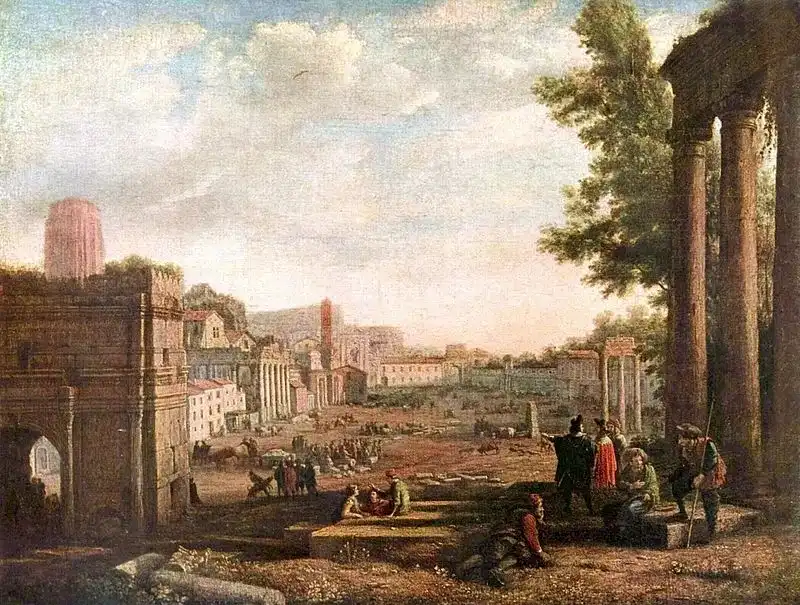
Cows and Temples By the Middle ages the Forum had been become an open grassy area with churches and a few buildings here and there. By the 17th Century cattle grazed between the columns and the area was known as Campo Vaccino – The Cow Field
Recent Excavations In February of this year a shrine and sarcophagus dating back to the 6t century B.C. (which may be a shrine to Romulus). The forum never ceases to yield amazing fresh treasures!
Discover More


Frequently Asked Questions
What does Forum mean?
The Forum was a large rectangular square used as a meeting and market place. It was the political, religious and commercial heart of Rome, like our city centres or town squares.
What happened to all the buildings?
By the 7th century the Forum was abandoned, earthquakes toppled its structures, and floods filled it with sediment. By the Middle Ages it was buried and built over entirely.
How long did it take to excavate the Forum?
Formal excavation of the Forum began in 1898, but the site had been built over for centuries. It took around 100 years to uncover what we see today, with excavations still ongoing.
What happened to all the marble?
Much of the Forum's stone was stripped over centuries. By the 15th and 16th centuries, popes and aristocrats took its marble to decorate their new palaces and churches.
What time period is the Forum?
Archaeologists uncovered layers spanning centuries. Some areas sit at late 1st century BC, while surviving buildings date from the 6th century BC to the 4th century AD
Where was Julius Caesar killed?
Not in the Roman Forum. At the time of Caesar’s assassination, the Curia was being rebuilt and so the senators met at the Curia of Pompey (Largo Argentina today).